

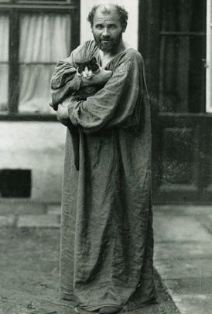
Left: Gustav Klimt in his studio garden. Circa 1912-14. Photograph.
Right: Poster for the First Secession Exhibition. 1898. Private collection.
Face Time
Self and Identity in Expressionist Portraiture
April 9, 2013 - June 28, 2013
Recent Acquisitions
(And Some Thoughts on the Current Art Market)
July 17, 2012 - October 13, 2012
The Lady and the Tramp
Images of Women in Austrian and German Art
October 11, 2011 - December 30, 2011
Recent Acquisitions
(And Some Thoughts on the Current Art Market)
July 5, 2011 - September 30, 2011
Recent Acquisitions
(And Some Thoughts on the Current Art Market)
July 13, 2010 - October 1, 2010
Recent Acquisitions
(And Some Thoughts on the Current Art Market)
June 24, 2008 - September 26, 2008
Transforming Reality
Pattern and Design in Modern and Self-Taught Art
January 15, 2008 - March 8, 2008
Recent Acquisitions
(And Some Thoughts on the Current Art Market)
June 5, 2007 - September 28, 2007
Who Paid the Piper?
The Art of Patronage in Fin-de-Siècle Vienna
March 8, 2007 - May 26, 2007
More Than Coffee was Served
Café Culture in Fin-de-Siècle Vienna and Weimar Germany
September 19, 2006 - November 25, 2006
Recent Acquisitions
(And Some Thoughts on the Current Art Market)
June 6, 2006 - September 8, 2006
* Coming of Age
Egon Schiele and the Modernist Culture of Youth
November 15, 2005 - January 7, 2006
Recent Acquisitions
And Some Thoughts on the Current Art Market
June 7, 2005 - September 9, 2005
Every Picture Tells a Story
The Narrative Impulse in Modern and Contemporary Art
April 5, 2005 - May 27, 2005
65th Anniversary Exhibition, Part I
Austrian and German Expressionism
October 28, 2004 - January 8, 2005
Recent Acquisitions
(And Some Thoughts on the Current Art Market)
June 24, 2003 - September 12, 2003
In Search of the "Total Artwork"
Viennese Art and Design 1897–1932
April 8, 2003 - June 14, 2003
Recent Acquisitions
(And Some Thoughts on the Current Art Market)
June 25, 2002 - September 20, 2002
Gustav Klimt/Egon Schiele/Oskar Kokoscha
From Art Nouveau to Expressionism
November 23, 2001 - January 5, 2002
Recent Acquisitions (And Some Thoughts on the Current Art Market)
June 26, 2001 - September 7, 2001
From Façade to Psyche
Turn-of-the-Century Portraiture in Austria & Germany
March 28, 2000 - June 10, 2000
Saved From Europe
In Commemoration of the 60th Anniversary of the Galerie St. Etienne
November 6, 1999 - January 8, 2000
Recent Acquisitions
(And Some Thoughts About Looted Art)
June 9, 1998 - September 11, 1998
Taboo
Repression and Revolt in Modern Art
March 26, 1998 - May 30, 1998
Recent Acquisitions
A Question of Quality
June 10, 1997 - September 5, 1997
The Viennese Line
Art and Design Circa 1900
November 18, 1996 - January 4, 1997
Breaking All The Rules
Art in Transition
June 11, 1996 - September 6, 1996
The Fractured Form
Expressionism and the Human Body
November 15, 1995 - January 6, 1996
Recent Acquisitions
June 20, 1995 - September 8, 1995
On the Brink 1900-2000
The Turning of Two Centuries
March 28, 1995 - May 26, 1995
55th Anniversary Exhibition in Memory of Otto Kallir
June 7, 1994 - September 2, 1994
Symbolism and the Austrian Avant Garde
Klimt, Schiele and their Contemporaries
November 16, 1993 - January 8, 1994
Recent Acquisitions
June 8, 1993 - September 3, 1993
Naive Visions/Art Nouveau and Expressionism/Sue Coe: The Road to the White House
May 19, 1992 - September 4, 1992
Scandal, Outrage, Censorship
Controversy in Modern Art
January 21, 1992 - March 7, 1992
Viennese Graphic Design
From Secession to Expressionism
November 19, 1991 - January 11, 1992
Recent Acquisitions
Themes and Variations
May 14, 1991 - August 16, 1991
Gustav Klimt, Egon Schiele, Oskar Kokoschka
Watercolors, drawings and prints
January 22, 1991 - March 2, 1991
Recent Acquisitions
June 12, 1990 - August 31, 1990
The Narrative in Art
January 23, 1990 - March 17, 1990
Galerie St. Etienne
A History in Documents and Pictures
June 20, 1989 - September 8, 1989
* Gustav Klimt
Paintings and Drawings
April 11, 1989 - June 10, 1989
Recent Acquisitions and Works From the Collection
June 14, 1988 - September 16, 1988
From Art Nouveau to Expressionism
April 12, 1988 - May 27, 1988
Recent Acquisitions and Works From the Collection
April 7, 1987 - October 31, 1987
Oskar Kokoschka and His Time
November 25, 1986 - January 31, 1987
Viennese Design and Wiener Werkstätte
September 23, 1986 - November 8, 1986
Gustav Klimt/Egon Schiele/Oskar Kokoschka
Watercolors, Drawings and Prints
May 27, 1986 - September 13, 1986
The Art of Giving
December 3, 1985 - January 18, 1986
Expressionists on Paper
October 8, 1985 - November 23, 1985
European and American Landscapes
June 4, 1985 - September 13, 1985
Arnold Schoenberg's Vienna
November 13, 1984 - January 5, 1985
* Gustav Klimt
Drawings and Selected Paintings
September 20, 1983 - November 5, 1983
Early and Late
Drawings, Paintings & Prints from Academicism to Expressionism
June 1, 1983 - September 2, 1983
Aspects of Modernism
June 1, 1982 - September 3, 1982
The Human Perspective
Recent Acquisitions
March 16, 1982 - May 15, 1982
Austria's Expressionism
April 21, 1981 - May 30, 1981
Gustav Klimt, Egon Schiele
November 12, 1980 - December 27, 1980
* Gustav Klimt
March 20, 1970
Austrian Art of the 20th Century
March 21, 1969
* Gustav Klimt
February 4, 1967
The Wiener Werkstätte
November 16, 1966
25th Anniversary Exhibition
Part I
October 17, 1964
Austrian Expressionists
January 6, 1964
Group Show
October 15, 1962
Gustav Klimt, Egon Schiele, Oskar Kokoschka and Alfred Kubin
March 14, 1961
Watercolors and Drawings by Austrian Artists from the Dial Collection
May 2, 1960
European and American Expressionists
September 22, 1959
* Gustav Klimt
April 1, 1959
Austrian Art of the 19th Century
From Wadlmüller to Klimt
April 1, 1950
Small, Good Art Works from the 19th and 20th Centuries
January 27, 1949
Franz Barwig the Elder, Franz Barwig the Younger and Gustav Klimt
March 12, 1948
Gustav Klimt, Oskar Kokoschka and Egon Schiele
September 15, 1945
Saved from Europe
Masterpieces of European Art
July 1, 1940
Group Exhibition
May 1, 1939
Austrian Art
February 1, 1939
Important Paintings
November 29, 1937
Anton Faistauer, Gustav Klimt, Oskar Kokoschka and Egon Schiele
June 1, 1933
Gustav Klimt and Bruno Lauterbach
March 29, 1928
* Gustav Klimt
May 20, 1926
FACE TIME
Self and Identity in Expressionist Portraiture
Beckmann, Max
Corinth, Lovis
Dix, Otto
Grosz, George
Heckel, Erich
Kirchner, Ernst Ludwig
Klimt, Gustav
Kokoschka, Oskar
Kollwitz, Käthe
Mammen, Jeanne
Modersohn-Becker, Paula
Motesiczky, Marie-Louise
Nolde, Emil
Pechstein, Hermann Max
Schiele, Egon
Schoenberg, Arnold
From infancy onward, humans are fascinated by faces, and the European portrait tradition dates back to classical antiquity. Although the genre was temporarily eclipsed during the Middle Ages, portraiture experienced a robust revival in the Renaissance. Thereafter, portraits served as a bulwark for European and American elites, affirming their authority and providing steady employment for generations of artists. That system, however, was uprooted by industrial capitalism, which undermined both the established elites and the practice of direct artistic patronage. Beyond such socio-economic factors, the so-called portrait crisis of the early twentieth century was intensified by revolutionary changes in the biological and psychological conception of self. Addressing this identity crisis with greater fervor than modernists elsewhere, the Austrian and German Expressionists felt compelled to invent new approaches to portraiture.
In the Renaissance, the term "portrait" was not limited to depictions of human beings. A portrait (ritratto in Italian) could be a likeness of any real subject, including also animals and even places. The quasi-mechanical process of mimesis (ritrarre) was distinguished from more imaginative acts of artistic interpretation (imitare). Eschewing the former in favor of the latter, artists considered portraiture an inferior field of endeavor; lucrative, perhaps, but creativly stultifying. In practice, portraits entailed a three-way exchange among the sitter, the artist, and a putative audience. Representational accuracy had to be combined with artistic invention in such a way as to locate the sitter within an appropriate social context. Subject and artist colluded in the fabrication of a socially sanctioned identity that was routinely reinforced through the use of props such as crowns, scepters, jewels, swords, books, globes and the like. Frequently these status markers overshadowed the sitter's personality; poses were usually formal and static, emotional extremes were avoided, physical flaws elided. Portraits were artificial constructs, and yet paradoxically, their function depended on a presumed verisimilitude. The portrait was a stand-in for the living person, representing the sitter when he or she was absent. Portraits converted transience into permanence, conjuring a self that might survive even death.
The dualistic conception of portraiture expressed by the Italian verbs imitare and ritrarre reflected a deeply entrenched privileging of mind over body. In Judeo-Christian theology, humans are distinguished from animals by the possession of souls that connect them to God. And yet if, as René Descartes and others believed, the body is a mere husk in which the soul resides, how could a portrait, a representation of this outer shell, capture the being within? That was the task of a great artist, an achievement that simultaneously ennobled him and his client, separating the portrait from mimetic craft by depicting the sitter's inner essence. The practice of correlating facial features with enduring character traits, which originated with Aristotle, was eventually codified in the pseudo-science of physiognomics. Human faces were ranked on a scale, from the base to the divine, according to the degree to which they did or did not resemble the faces of animals. Such rankings were used not only idealize the ruling elite, but also, by purporting to identify inferior human types, to justify horrific extremes of racism, sexism and genocide.
By the turn of the twentieth century, the premises supporting European portrait tradition were being systematically undermined. Amidst demands for equality and a socialistic redistribution of wealth, the legitimacy of the ruling class came under increasing attack. Karl Marx averred that the self has no autonomous existence, but is merely a product of its particular socio-economic environment. Charles Darwin posited an evolutionary connection between human and animal life that implicitly questioned humankind's link to the divine. If the self was only a biological artifact, dependent on the body for its existence, then the soul could not be immortal. Sigmund Freud, by demonstrating that conscious behavior is partly shaped by unonscious drives, further challenged the notion of a cohesive, rational self. The interplay between mind and body that was intrinsic to the portrait genre had to be renegotiated.
The realization that body and mind are inextricably joined blurred the boundary that had formerly distinguished the self from the outer world. Subject and object were enmeshed in a tautological loop: the self was no more than a response to external stimuli; reality no more than a projection of transitory, subjective states. It was no longer possible to conceive of a singular reality shaped by unified cognition. The shift from a fixed to a fluid conception of identity is dramatically represented in early twentieth-century Austrian and German portraiture. Gustav Klimt's society portraits, which consist almost entirely of status-affirming surface decoration, may be considered a last, glorious flowering of the old guard. The portraits of the younger Expressionist generation, with their blank backgrounds, offer a glaring contrast. Gone, for the most part, are the props that once symbolized a sitter's social identity. We stare into the void, and the sitter stares back.
Portraiture still entailed a three-way exchange among sitter, artist and viewer, but the nature of that relationship had fundamentally altered. To explain this change, turn-of-the-century art historians developed the theory of empathy aesthetics, which held that an artist's emphatic insight into the sitter resulted in a portrait that would be comprehensible to similarly empathic viewers. Theorists quibbled as to whether the empathic response was innate (that is, an unconscious reaction to primal visual schema), learned (dependent on the specific education and life experiences of the artist and viewer) or some combination of the two. Realistic verisimilitude scarcely mattered in the new order of things. Indeed, it could be hard to tell whether a portrait represented the sitter at all, or was purely a product of the artist's subjective interpretation. As Oscar Wilde observed, "Every portrait that is painted with feeling is a portrait of the artist."
Both literally and figuratively, the importance of the sitter dwindled in the modern era. Portraiture was no longer the prerogative of kings and industrial potentates. Photography made it possible for anyone to have his or her likeness taken. Additionally, the advent of commercial art galleries disrupted the direct contact between artist and patron that had been instrumental in fostering portrait commissions. Artists were encouraged to paint other subjects that would appeal to a broader general audience. In Austria (where commerical dealers would not become a force until after World War I), Oskar Kokoschka and Egon Schiele still sometimes had trouble collecting payment from dissatisfied portrait clients, but on the whole the modern art market shifted financial control away from the sitter. Now it was the artist who conferred honor on his chosen subject, rather than vice versa. As Arnold Schoenberg (who made an abortive stab at an artistic career around 1910) wrote a prospective dealer, "You must not tell people that they will like my pictures. You must make them realize that they have to like my paintings, because...it is much more interesting to have one's portrait done by a musician of my repuation than to be painted by some mere practictioner of painting whose name will be forgotten in twenty years." Having one's portrait done by a member of the nascent avant-garde confirmed for posterity that one had actually sat in the presence of a genius.
While the Austrian and German Expressionists continued to receive portrait commissions, most of them also created, gratis, paintings and drawings of people who appealed to them visually. Images of family and friends provide intimate glimpses into an artist's personal life, but other unpaid portraits can be surprisingly generic. Titles such as "girl," "man" or "woman" proliferate in the Expressionists' oeuvres; depictions of sitters not considered important enough to name and now entirely forgotten. In these works, the artis's vision totally eclipses the identity of the subject. Some sitters--especially in the politically volatile Weimar years--were selected because they represented distinct social types. Such a subject is Otto Dix's Old Woman at the Café, a once-proud member of the bourgeoisie who has evidently lost everything to postwar inflation and now sits forlornly with her little cup of coffee. Käthe Kollwitz made a lifelong specialty of downtrodden women: exploited workers, bereft widows and the like. Whereas commissioned portraits require a degree of accommodation between sitter and artist, this mutuality is lacking in most unpaid likenesses, and one wonders whether such works can really be classified as portraits.
To the extent that the Expressionists did engage with portraiture in the more traditional sense, they were forced to confront the evanescent nature of identity. One approach was to ape the photographer's art by depicting momentary states. Expressionist portraits were consequently more emotionally charged, less static, than their predecessors. Kokoschka, for example, executed a series of drawings, later published as lithographs, that depict the trancelike reverie experienced by women listening to music. Schiele, who could draw with photographic speed, created likenesses that replicate the spontaneity of snapshots. Towards the end of his brief life, as his reputation soared, he received a spate of portrait commissions. Studies indicate that Schiele approached these assignments much like the academic portraitists of yore, focusing on the face and hands as the symbolic windows on the soul. He even sometimes added supplemental props. In his drawings of Franz Martin Haberditzl, director of the Austrian National Gallery, the sitter is shown leafing through a sheaf of drawings, which in the completed painting are revealed to be works by Schiele himself. The props here represent an implicit compact of mutual support between the artist and his subject. Schiele's late portraits are among his more conventional works, but they reflect the circumstances current at the time of execution rather than making any claim to eternal validity.
A true portrait, like Oscar Wilde's Picture of Dorian Gray, would have to change along with its subject. Many Expressionists addressed this issue by producing multiple self-portraits over the course of their careers. Schiele, who was scarcely more than a boy at the time of his creative breakthrough in 1910, examined his identity piecemeal, trying on various personalities that may or may not add up to a complete human being. For artists such as Lovis Corinth and Kollwitz, who lived into old age, the accretion of identity was cumulative, the outcome fully evident only at the end. Corinth's self-portraits, which early on exude professional pride and success, gradually dissolve under the pressures of physical frailty and postwar social collapse. Kollwitz, on the other hand, evidences a tight-lipped stoicism that barely changes over the course of half a century. In their poignant melding of sadness and strength, her self-portraits are almost indistinguishable from her portraits of other women.
Female artists like Kollwitz brought unique insights to their portraits, especially of women. The portrait genre, after all, had been created by and for men. Traditionally, depictions of women were more decorative and colorful than male portraits, because women were believed not to have unique selves. Expressionist portraiture entailed a more probing relationship between sitter and artist, but to the extent that most artists remained male, female subjects still often got short shrift. Women artists were less inclined than their male colleagues to objectify women. Sexual allure was to them not a source of voyeuristic pleasure, but an aspect of femininity worthy of deeper analysis. Kollwitz tended to see feminine identity largely in terms of motherhood, while artists such as Jeanne Mammen, Paula Modersohn-Backer and Marie-Louise Motesiczky explored their gender as a source both of sexual power and vulnerability.
Of the female painters active during the Expressionist period, few were as consistently engaged with portraiture as Motesiczky. Her portraits are curious admixtures of the avant-garde and the traditional. The sitters seldom paid, but instead were usually selected by the artist on the basis of their emotional appeal. Motesiczky was therefore able to give her imagination free reign, yet the resulting portraits retain a degree of verisimilitude sufficient to convince the viewer that they are credible likenesses. Motesiczky's crowning achievement is a series of paintings depicting her mother, Henriette, an artistocratic Austrian Jew who fled to England with her daughter after the Nazi Anschluss in 1938. Throughout the series, Henriette appears well fed (in fact obese), her wide eyes tracing a trajectory from privilege to loss without ever forfeiting an essential guilelessness. Like the extended self-portrait sequences created by other Expressionists, Motesiczky's mother paintings depict the self as a process of becoming, rather than a stable entity.
In his recent book, The Age of Insight, the Nobel-Prize-winning neurobiologist Eric Kandel compares Expressionism to the practice, developed simultaneously at the Vienna School of Medicine, of correlating autopsy results with clinical examination. "Only by going below surface appearances," he writes, "can we find reality." Nonetheless, however much the Expressionists attempted to go below the surface, the inner being was elusive. The dissolution of the traditional boundary between body and mind had left the self adrift, muddling objective observation with subjective sensation. A portrait's three-way amalgamation of the sitter's physical appearance, the artist's personal interpretation and the viewer's subjective response remained ambiguous. It is only today, through recent advances in neuroscience, that the mind/body split is finally coming to be healed. As Kandel observes, we are starting to "understand the mind in biological terms." It remains to be seen how this new, biological self, which the Expressionists sensed but could not fully grasp, will influence portraiture in the future.